

In the process of fitting a brake light to my recently acquired Model 30, I have discovered that the dynamo is not wired into the system, and there is no regulator to be found. The bike has been wired for positive ground, which is incorrect for the year and counter to the wiring diagram. I took the dynamo cover off, and everything appears to be OK, the two brushes are in good shape and the commutator is clean and smooth. First question is, with the engine running, can I simply check that the dynamo is working by testing for voltage at the two output poles? Also, how would the regulator mount? The book says it is on the offside rear stay. Would anyone have a picture that would help? Plan is to rewire the bike complete with the correct colour wires.
Thanks for any guidance!
Bill
Firstly, are there no wires…
- Log in to post comments
The Inter might well have…
The Inter might well have had a racing mag and not a magdyno.
Mine (1932) has a modern regulator mounted on the cross connector plate between the two upper rear chain stays below the saddle, because it has no lugs on the frame.
The usual position for prewar rigid Nortons was on brackets brazed to the frame on top of and half way down the right hand upper rear chain stay tube, above the toolbox.
You can of course repolarise a dynamo to whichever polarity you wish. But Al gets rightly very cross if you end up with the wrong colours for live and earth! Prewar colours weren't the same as post war.
- Log in to post comments
Half right
Jon is half right, Connect D to F yes, but use a headlamp bulb (12V) to earth. If the bulb is bright at a fast tickover then you have 45W?
Polarity? Item on my web site covers this but if you change the polarity then you really should change the earth wire colour to comply, wrong colours-earth wire will lead to confusion and maybe expensive smoke!
The dynamo does NOT have two outputs.-the D is the output and the F is the input that controls the output via the regulator.
- Log in to post comments
CVC Fittings
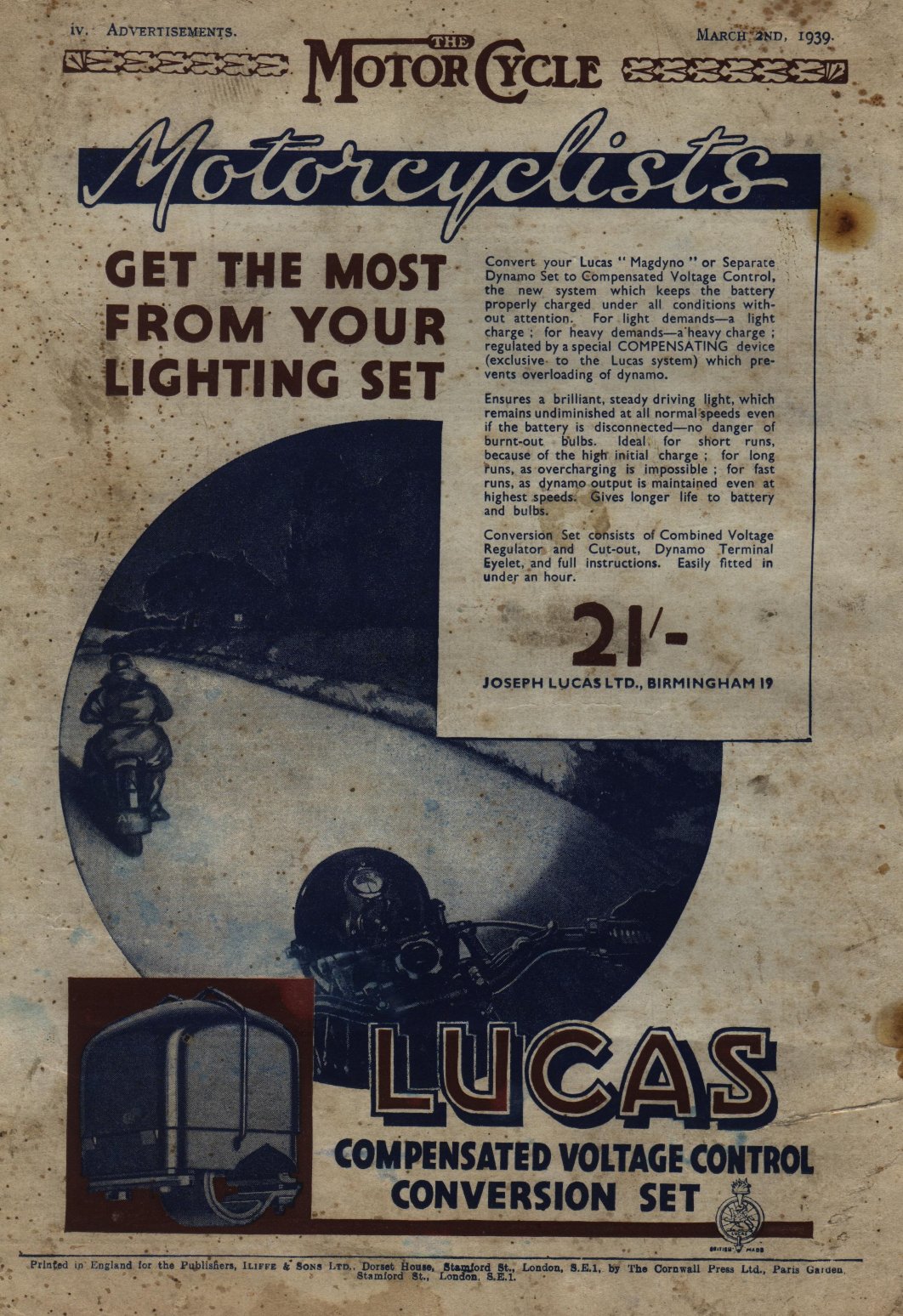
Norton (and also Triumph) used the clamp-on type MCR1 that Lucas standardised as their upgrade kit. Most manufacturers used the version with two feet. Fitment was above the toolbox which has the advantage of keeping road dirt off the base but means that the toolbox has to be removed first if the regulator needs attention.
The clamp type are less common but the other type can be converted. The clamp has two hooks and the slotted plate for these is present on all types. The feet have to be ground off, two 'V's cut and a small retaining plate for the clamp fabricated and tacked onto one edge.
I can supply more photos, but the 1939 advert gives the general idea.
- Log in to post comments
Thank you all for the info…
Thank you all for the info. I'll fire up the bike tomorrow and see if we have a working dynamo. I'm always amazed at how the factories would find ways to mount ancillary bits! Might be a fun project to fix up a mount like that. The PO merely stuck the wires into holes and left it. Not a big deal to do a rewire, not my first.
Bill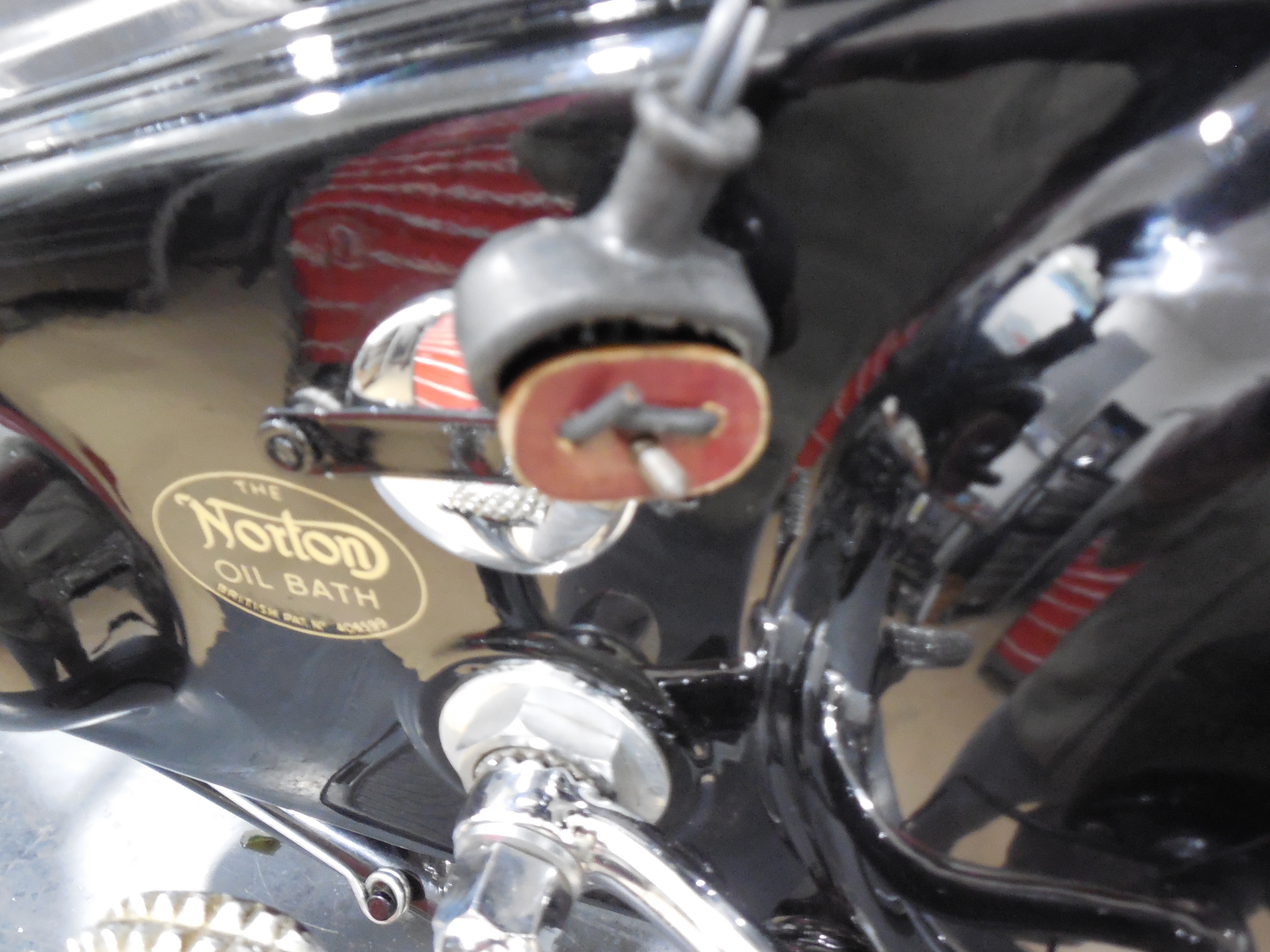
- Log in to post comments
Re-wire
I can supply rewire kits for dynamo and alternator British bikes, the kits include post 1963 colours (tracer) some of the original early colours are not available these days and retaining the original colour system can generate confusion. (dip/main cables both black!)
Original looms? If for any reason you move a switch or it is non original the 'original' loom can become a nightmare to fit/connect.
Don't forget the Vreg electronic regulator.
- Log in to post comments
Depending on your use…
...of the machine, (which looks to be very smart). If you intend using it and you don't have a regulator with it then go for the VReg, it's cheap simple and robust, fit and forget.
If you want to preserve some form of originality you can fit the VReg inside an MCR casing and still have a reliable system. If you are hunting for an original or already have one get it set up properly. They can work well but they do go off due to the frequency of contact closure.
looks like the PO was progressing with wiring but did not complete. Cable size especially for the "D" terminal looks a little light so rewiring with a good loom is a good way forward. I thought brake lights were mandatory post 37?
Are you plunger (option from 37) or rigid?
Cheers
Jon
- Log in to post comments
Plunger
Plunger rear on this bike. I just had that apart just to look over and service. The old grease was getting pretty stiff, but all in good nick. I just ran the bike with a bulb connected and nothing. Looks like the dynamo is off to be looked at while I refurbish the wiring.
Bill
- Log in to post comments
Oh dear!.....
I forgot a basic, first of all you need to polarise the dynamo. We all know how to do that!!!
Battery must be connected to Earth as intended to use. then take a 'live' wire to the F terminal of the dynamo for a few seconds, at removal this wire should spark, this says you have done the job right and you have a Field coil connected to the F terminal. This polarises the Dynamo and needs to done before you try the output test first, As in the details of the fitting sheet for the V reg.
It is always a good idea to ascertain the Dynamo has an output BEFORE you try using the Vreg.
- Log in to post comments
Yes I suspect most early…
Yes I suspect most early plungers are in need of a clean out. When I first had mine I thought it a worse ride than my previous rigid, but after a strip out and clean up the advantage was evident.
With regards to testing take a look here...
https://partsbooks.britishonly.com/partsbooks/PDF_Files/lucas/Lucassection2combined.pdf
If you are in need of a replacement dynamo direct mail me...
J
- Log in to post comments
Success!
So nothing was working, took it apart to clean up the comm, which was in nice shape, just a little dirty. Still nothing, then I had a think after looking at the bike wiring diagram, and realised it was connected all wrong. Both of the field wires were connected to the output poles, one each. So I rewired it correctly and it motored nicely. Installed it, started the bike, still no output. Realised the rotation was wrong, switched the field wires, and we have light! Thanks for all the info, now I can get the bike wired up and move on to the next task, stripping the front forks. Steering head bearings are loose and I want to go over it anyway.
Bill
- Log in to post comments
Well done
As Alan said make sure you polarise the dynamo to the correct polarity for your machine.
The document I sent a link to, describes how it all works.
I take it it's a girder fork setup. You mention it's loose. Just check where the looseness is, steering head bearings or girder spindles. Headstock bearings quick and simple to change or adjust, girder spindles a bit more of a challenge if worn.
J
- Log in to post comments
Jon not quite so...
Jon-'Correct polarity for your machine' is not a definitive statement. Yes the modern Norton (50s-76) were all positive earth and prewar were possible Negative earth. But the polarity you chose/end up with is your choice see my web site on the subject. The polarity of Earth of the machine is NOT crucial until you add electronics ie electronic ignition, electronic regulators, or LEDs You can change the polarity of ANY machine as you so desire, but you must understand what you are doing and why.
- Log in to post comments
Polarity
All true. I chose negative ground because A, that's how it was built originally, and B, it will make it easier if I want to install an LED tail light bulb. The rear light is so tiny it needs all the help it can get and I might add an LED beneath the license plate as well. Drivers today do not pay attention and I want to be seen.
- Log in to post comments


Firstly, are there no wires to the F and D terminal on the dynamo? To test it in situ short these two terminals together and test between the the frame of the dynamo and the shorted terminals. A voltage. Should appear on tick over them raise the revs to see a fluctuation upwards do not rev too high. Alternatively, with the dynamo removed from the machine connect to a battery, shorted terminals and frame, the dynamo should run like a motor.
If you decide to use this dynamo you will have to polarise and confirm it's output voltage to build into your system.
The regulator, often an MCR2 would be situated on the offside rear stay though some are on the near side as it convenient for connecting to battery. They have two mounting types, flanged ends or clamp plate, yours would need the clamp plate if you can find one.
Alan O will be along shortly, he has all the knowledge and material to rewire this machine, alternatively there are on line suppliers of looms.
