

Nearly finished refurbishment of my Mk.3 and slightly worried about the amount of muscle required to pull the clutch lever in!
the cable is nicely routed and lubricated, with the adjustment as per the manual.
From previous posts, I understand the clutch stack height will make a big difference.
I see RGM do a 3 & 4mm plate. What should I go for, is there a chance the 4mm plate won't go in if there is little wear on the original plates? And does the new plate replace an original or go on top?
Any advice, other than building my hand muscles, would be greatly appreciated.
Clutch adjustment has kind…
- Log in to post comments
Are the plates bronze and…
Are the plates bronze and have you screwed out adjuster by a whole turn, as in Haynes? I experience a lever action with a hump but in use it's not tiring.
In its original form it is a good clutch but there are so many variables, all mysteriously interconnected, and that needs forensic attention to info gathering. As it turns out I need to revisit oil pressure, the shims in the oil pressure relief valve (maybe not ness with a new spring with better tolerance?!) as the primary gets engine oil leaking from the crank oil seal, and the clutch likes 200ml of oil but not a lot more. Who knew? Sent me down a clutch/gear selection rabbit hole.
Thats why I asked if its standard as so much advice seems tailored to mods which is why I forgot Haynes for a year and had guru's turn back the adjuster by a quater, a half turn ..and there was no 'hump' but drag and slip and a gearbox issue, all not applicable! I even have a pushrod seal for (no) leaking gear oil which I'll fit one day for the hell of it. Also carry a magnet in tool kit to retrieve that adjuster nut from the primary via the inspection cap when it shakes loose on first long motorway run, that fix really impresses modern bikers done on the hard shoulder.
- Log in to post comments
Your pressure relief valve…
Your pressure relief valve has nothing to do with engine oil getting into the primary case, Your crankshaft oil seal is knackered.
- Log in to post comments
not knackered
its new ish AN. But an easy fix if you think that's it. Thanks. A lot on oil pressure in the forum recently so I won't bother with a gauge, and a pressure relief valve also looks to have divided opinions and it wasn't needed in 1974 so why now? There's even a CNN o ring to fit between crank seal and sprocket available to stop the seal blowing out but I'm still confident I've missed something obvious, like the pressures a bit high. Easy answer is to leave the primary drain plug out for now. Works for me.
- Log in to post comments
Engine oil pressure does not…
Engine oil pressure does not cause an increase in crankcase pressure, and that is what is causing the leak from the crankcase seal.
If you believe the seal is good, and you do have excessive crankcase pressure, then that needs investigating.
Breather blocked, rings or guides really worn, too much oil in the sump when starting (wet sumping), not much else I can think of.
The fact the seal is new, does not mean it is doing its job properly.
- Log in to post comments
I have a new seal
plus the new mainshaft circlip ready to pull the lot off. Primary side has been the most dismantled bit since rebuild but each time I form a better understanding. I now can't remember if the basket also had some notching when I replaced the centre so I get the chance to inspect it again and shuffle the plates this time. It generally all works well now but there is so much more to this than following Haynes to the letter. Thanks for the advice and I hope it helps any others with their shakedown too.
- Log in to post comments
cable ties
Peter F.,
if you have the clutch cable secured too tightly to the frame tubes with cable ties or whatever, then that can also cause a stiff clutch lever operation.
Allow the clutch cable to flex freely and try the clutch operation again.
Hope this helps.
- Log in to post comments
The answer - The first thing…
The answer - The first thing to determine is what pressure plate you have as that dictates how many clutch are plates needed.
Thin pressure plate = 5 friction, 4 plain
Thick pressure plate = 4 Friction, 3 plain.
In either system many found that substituting a plain steel plate with a 3mm plate will lighten the clutch. It is a substitution and not a stuffer plate.
The above has known fail, but it is usually an 850 where the sintered plates have been replaced with old Barnett plates, the original Barnett 850 plates where undersize up until 4 years ago or so, they are now all the correct thickness and work very well even if contaminated.
Sounds simple, it really is, but every month the workshop see bikes with a mix of plates various.
- Log in to post comments
3 & 4 mm metal clutch plates.
Its an easy fix trying out thicker metal clutch plates so I would try that first. I could not believe how much easier it was to pull my clutch in after fitting a thicker plate. Get a 3mm and a 4mm from RGM for about £7 or £8 each plus VAT and postage. That way you can increase stack height by 1,2 or 3mm as the standard ones are about 2mm.
if you can just get the large circlip in the groove to hold the diaphram spring in place then that should hopefully do it. Just check at different rpm and speeds that the clutch is not slipping. While the plates are out give them a wash in petrol and let them dry. Once dry rub them on wet & dry or Sandpaper on a flat surface to remove any glaze on the fibre plates. Hopefully your clutch is standard like my 1972 750.
- Log in to post comments
Removing glaze?
Thanks for all the advice so far.
I've ordered a 3mm plate from RGM.
My clutch has the bronze plates, should I rough up all the plates after washing in petrol?
Cable runs freely, and smoothly, so no problems there as far as I can see.
- Log in to post comments
Hi Peter,Are you aware that…
Hi Peter,
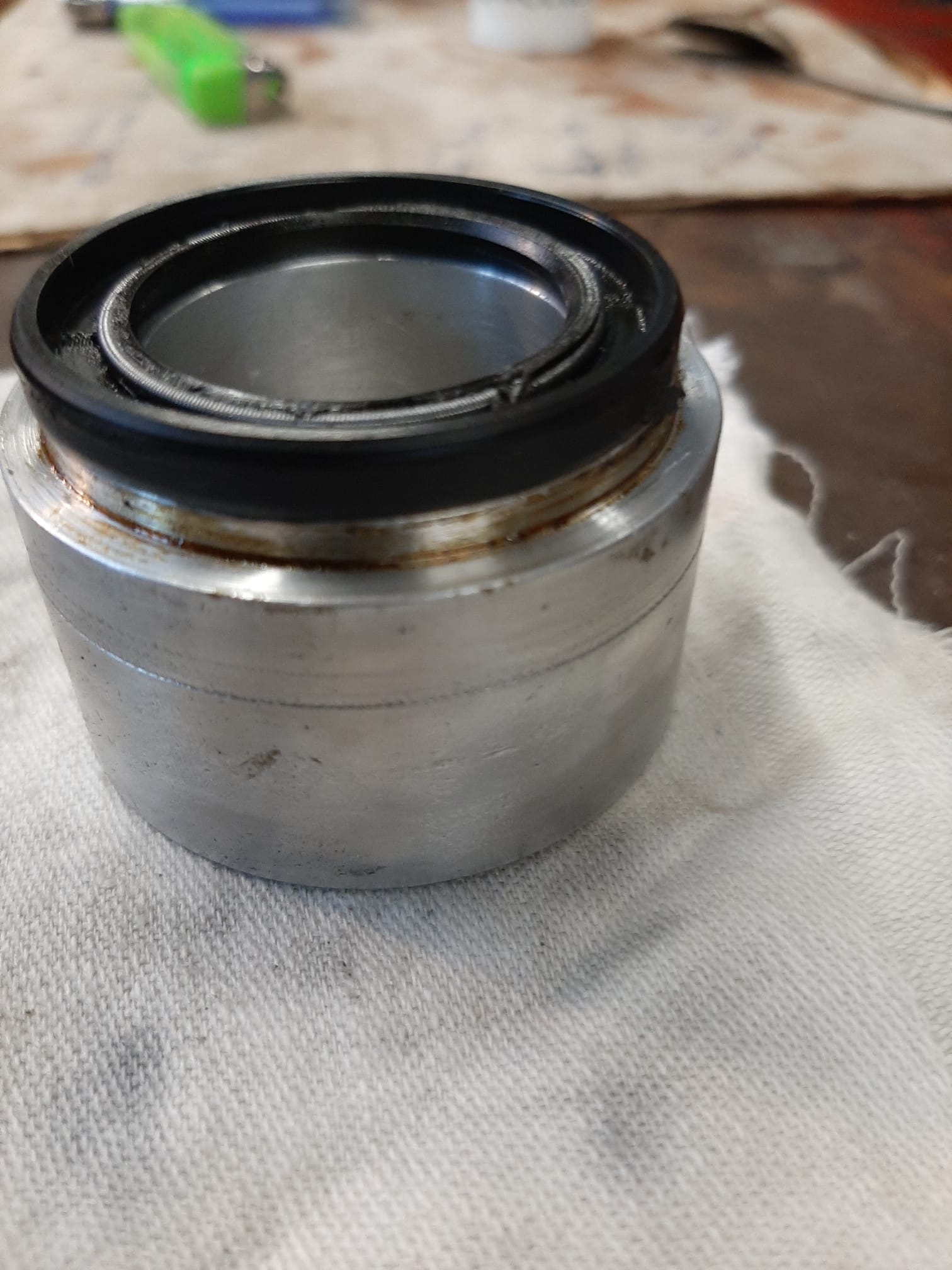
Are you aware that the oil seal can easily be pushed in too far? The attached picture shows one removed from a leaky bike. It is sat atop the special insertion tool that pushes it in exactly the right amount. You can see where the crankshaft has eaten into the oil seal.
Once pushed in too far, it cannot be pulled back out again without causing damage.
Regards
Tony
- Log in to post comments
that is news about oil seal, thanks!!
also apologies if my own clutch 'journey' has diverted attention but oil level is of primary (!) importance once its all set up, and by the way I found a pint of petrol in primary cleans ok!
- Log in to post comments
If you read the full thread…
If you read the full thread. It diverted at one point to include oil leaking into the primary.
- Log in to post comments
Stiff action
If the cam on the lever, in the gearbox inner cover, is worn, it will make the clutch hard to pull in.
- Log in to post comments
All good now
It's a new lever Gary.
Thanks for all the advice guys. Fitted the new 3mm plate today and the clutch is now quite usable.
- Log in to post comments
Fuel in the primary can…
Fuel in the primary can explode and fracture the case.
- Log in to post comments


Clutch adjustment has kind of been done to death so reading previous discussions and deciding which works for your case is the best approach.
The thicker steel plates are used to replace one of the originals so as to increase the stack height as desired and move the engagement point along the spring pressure curve.
As for the effort required to operate the clutch, it depends what you're comparing against: a Jota or a CBR600 :)
The clutch will be initially heavy and then 'snap-over' as the diaphragm spring does its thing. You can play around with the adjuster screw in the clutch to find a position that works for you - it's a 20tpi thread so one full turn equates to 1.27mm - and add/remove steel plates to get somewhere close
Your next problem is likely be clutch slip - also covered extensively here.