

Hi all,
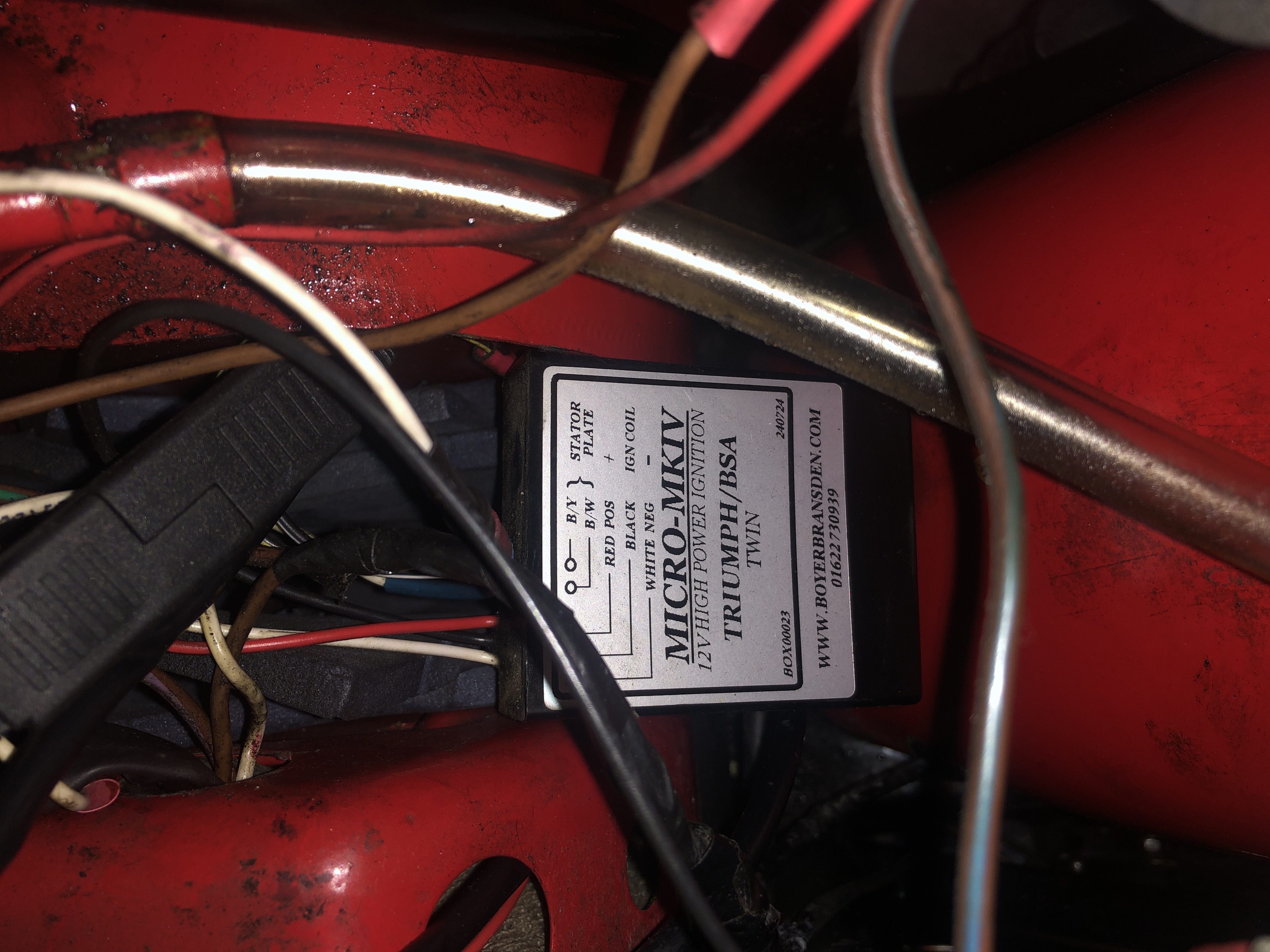
A bike I bought a year ago is fitted with a Boyer Bransden electronic ignition. The bike starts easily, ticks over well and seems to have the sort of urge I might expect in the lower and intermediate rev ranges. Carburation seems spot on by the colour of the plugs. The bike seems unwilling to reach maximum revs and the top speed seems to be no more than 80mph.
I want to check the ignition timing, Because it is electronic I am going to have to use a strobe light (for the first time). Can anyone advise what the degrees figure is fully advanced BTDC? The book I have assumes static timing only. (9/32" BTDC)
If anyone else has fitted electronic ignition to a Dominator 99, what product did you use. I was s bit disconcerted to find that the kit fitted to my bike is for a BSA/Triumph. I am wondering whether it is retarding as the revs increase instead of advancing?
Any help or advice gratefully received.
Geoff
When fully advanced the…
- Log in to post comments
Static means retarded . The…
Static means retarded . The book only quotes fully advanced .
- Log in to post comments
I am no expert but the way I…
I am no expert but the way I have always timed old bikes is to statically time them at the fully advanced position (e.g. 9/32" BTDC). The figure given in the handbook is nearly always for the fully advanced position. It would either be necessary to wedge open the bob weights on an old auto advance/retard mechanism or set the manual adjustment on the magneto to fully advanced. With the piston set at the specified position, the contact points are then set just about to open (often using the traditional fag paper). In my understanding 'static' does not mean retarded it means what the word means. i.e. stationary, not moving.
- Log in to post comments
Timing a bike with a static…
Timing a bike with a static engine is a common way of doing it with a mag or distributor and involves artificially advancing the timing to replicate what will happen at high revs.. it is however not the static timing . this is the measurement of the point of firing when the engine being turned over slowly as in starting. Not used much except sometimes to ensure that the bike will not kick back too much. If you ever owned a Ducati single built with 28 degrees advance static timing you would appreciate the difference ! . Bump start only . Not suitable for the road.
- Log in to post comments
Look again at the data.and…
Look again at the data.and what you said. it states fully advanced , NOT static . if it were to quote static it would be closer to TDC perhaps 5 degrees before . Its not used or often quoted.
- Log in to post comments
Hi Robert, It seems we just…
Hi Robert,
It seems we just have a difference in understanding what 'static' means in this context. For me it means timing the engine by setting the piston at the measurement figure given in the book BTDC. In tihs case 9/32" BTDC. This being the fully advanced position. Non static timing in my understanding is done by fitting a timing disc and marking up with pointers etc the number of degrees that fully advanced firing should occur BTDC. This for my bike I have been told is 32degrees. A strobe light is then used to check this with the engine running (i.e. not static). Degrees BTDC were not usually given in original books of machines of the 1950s because owners did not have strobe lights and timed their machines statically not with the engine running. I therefore believe the two figures are synonymous. Winding the piston down by 9/32" will indicate as 32degrees on a timing disk if it was fitted.
Geoff
- Log in to post comments
Regarding timing..out of…
Regarding timing..out of curiosity, which manual do you have? My Haynes gives 32 degrees. My F Neill also has 32 degrees, as does Bacon.
Since the plugs at 30 degrees off the vertical, piston drop gets complicated to calculate and to use.
If it gets up to 80 and no more, main jet might be the problem. Are you certain the throttle and air slides go all the way up?
- Log in to post comments
I agree there may well be…
I agree there may well be other reasons for lack of top end performance.. I know the main jet is correct. I need to check carb for full movement. The only manual I have is the original Norton book, which assumes the bike has a distributor with contact points and coil.
- Log in to post comments
Main jet 'correct'
I would be wary of the main jet being 'correct' based on the original specs from the time of manufacture. Fuel formulations and many other minor changes, wear and bike-specifics mean that many owners find that the optimum jet size varies from 'what the book says'. It pays to experiment with a few different sizes, and it is only the work of a few minutes to change the jet, until you find the optimum point for your bike. From memory, for my 1958 99 I found an increase of 10 or 20 on the standard (1958!) sizing worked best.
- Log in to post comments
Ignition timing
Fully advanced ignition timing is the only one to worry about and it is a figure for the engine, (not specific to electronic ignition ie electronic does not change it although the fully advanced position might push the range further)
What you get fully retarded is almost academic.Retarded ignition is for easy starting and low speed running, the engine might run hot and poor if it is out but fully advanced out will kill an engine. If the Fully advanced point is out for any length of time you break your engine.
Further-the BSA/Triumph ignitions from Boyer Bransden and the Norton ones are exactly the same, the advance curve suits both engines.
- Log in to post comments
I make sure the main jet is…
I make sure the main jet is too big, then try smaller ones until correct.
First you'd better strobe time it to the recommended figure at Boyer's recommended RPM. Retarded timing will certainly limit your speed.
The reason I ask about maximum speed in third gear is that's the way I find a bike's top speed: maximum revs in third, then change up.
Some owners mess about with sprockets and make the bike too high geared to reach peak revs in top gear.
- Log in to post comments
I have checked the main jet…
I have checked the main jet. It is a 280 and the book says 250. I will experiment. I have checked the carb and it is a 376/5 which has the correct 1" 1/16" choke size and the slide is fully lifting on full throttle. I am thinking I may be able to check the timing by putting the strobe on the pickup. This would save removing the primary chaincase and fitting a disk etc. I am coming to the view that it is probably OK anyway. I have done some long trips on the bike, cruising 2 up at 65-70 without any ill effects, so I am figuring the timing can't be far out. I have ordered a cheapo chinese inductive rev counter so that i can actually see what it is doing.
- Log in to post comments
Maybe I have made an improvement
I am loath to take the primary chaincase off. It is oil tight and I want to keep it that way as long as possible. So I set the engine at TDC and the electronic stator plate seemed set up in the correct position. I then wound the engine back until a rod down the plug hole indicated that the piston was down by 7mm which is as near as dammit the correct figure. I then made a little paint mark on the plate where the spinning sensor thingie should be when fully advanced. I then fired it up and put the strobe on it. It seemed to me the sensor was not reaching my mark. There is a small adjustment on the plate and I slackened the nuts and advanced it as far as it would go. It is still not quite reaching my mark with the strobe but does seem much more willing to completely rev its nuts off.
Out for a road test tomorrow!
- Log in to post comments
What revs?
Hi,
Boyer usually quote to check full advance at 5000rpm! In this situation, it is best to have an assistant to sit astride the bike with it off the stand otherwise it will be 'walking' around the garage if you do it on the stand on your own.
Also, any marks on the pick up plate/rotor will ned to be very fine and accurately done as the angle will be halved.
Old school 'check' was if chrome on pipes has gone blue, it could be running retarded.
If its 'pinking' it is over advanced.
Hope this helps,
George
- Log in to post comments
Hi George, Thanks for your…
Hi George,
Thanks for your reply. I think you are right. After advancing the ignition as far as I could on the pickup unit I took it out for a run. It ran terribly. I put it back to where it was and it runs well again. I have come to the conclusion that because it runs so well at 'normal' speeds any shortfall in top end performance must be for reason unrelated to ignition timing. I shall wait for my cheap Chinese rev counter to arrive and experiment with different jets.
Geoff
- Log in to post comments
Have you checked?
Are you certain the throttle and air slides go all the way up?
There is no indication on this post that you have checked full lift.
I had this before on a car engine, said to a friend in the cab 'full throttle please' he said 'it is!' I was looking at the butterfly at 2/3. needed 'throttle adjustment!'
Until you have peered down the carbs and stuck your fingers up there!(!) you can't be sure.
- Log in to post comments


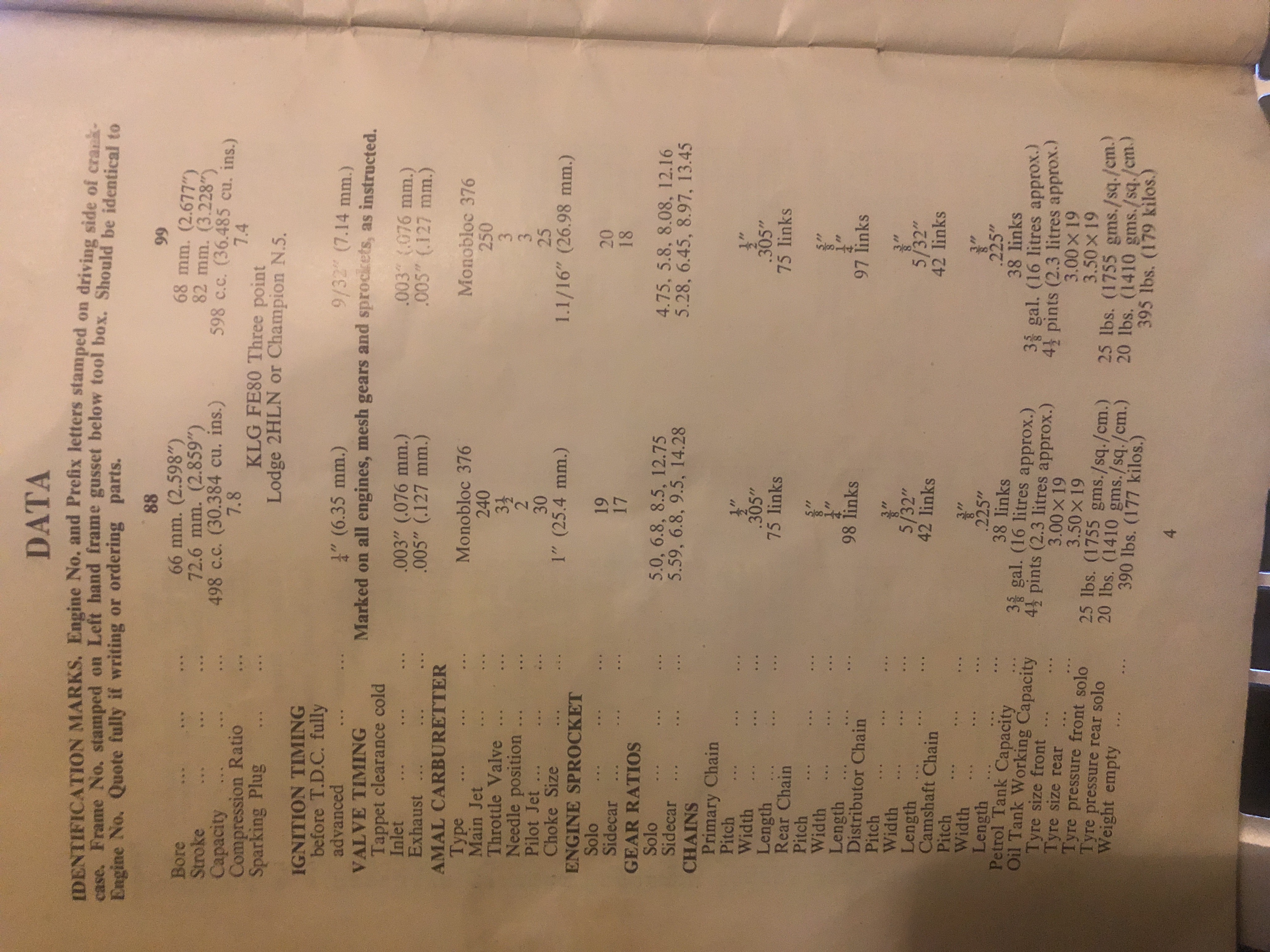
When fully advanced the timing should be 32 deg. which probably equals the 9/32 advanced setting you (mistakenly) quote as the static setting.